7/26/14

On Internet Plagiarism

Former President Richard Nixon is not
mentioned in the article
BuzzFeed reports they have fired their Viral Politics editor Benny Johnson.  Editor Ben Smith posted an apology to readers saying "After carefully reviewing more than 500 of Benny’s posts, we have 41 instances of sentences or phrases copied word for word from other sites. "

BuzzFeed is known for click bait style articles, so it was surprising to find they had any guidelines whatsoever.  This announcement made me curious how and where they had determined Johnson had crossed the line.  In Smith's apology he wrote "We have corrected the instances of plagiarism, and added an editor’s note to each."  So, I decided to find out what they had changed to avoid the plagiarism.

One of the articles that was plagiarized was called "24 Delightful Inauguration Firsts."   Calling it an article is being generous. It's 24 sentences about "inauguration firsts."  From the URL, I can determine it was originally 23 sentences, but Johnson must have added one.

Using google, I was able to pull up a cached version of the article from July 18th, 2014.

Smith mentions that many of the facts in this article were copied from a Senate website article about the inauguration called "Facts, Firsts and Precedents."

Let's put all three articles under a microscope for a moment. The original source Senate article had a sentence about Calvin Coolidge: "First Inaugural ceremony broadcast nationally by radio."  Former BuzzFeed author Benny Johnson appears to have copied verbatim most of that sentence: "Coolidge had the first inaugural ceremony broadcast nationally by radio."  In the revised article, BuzzFeed editor Ben Smith edited the sentence so it wasn't an exact copy: "Coolidge had the first inaugural carried on the airwaves."  Smith also added a link to the original source.

So, is it plagiarism? Technically, Ben Johnson's sentence is 70% the same as the original, so yes. But, there are so few words, is it really plagiarism?

One definition of plagiarism is "an act or instance of using or closely imitating the language and thoughts of another author without authorization and the representation of that author's work as one's own, as by not crediting the original author."

By that definition, even the revised sentences could be seen as plagiarism, except that they've cited the original source.

Bottom line, to avoid plagiarism on the Internet it seems like if you're using another source,  the best practice is to always cite that original source.  Of course, it's also up to the editors to point out a lack of sources, and ask for those from the authors.

Here are some other differences from Johnson's and the revised articles.

14. Harding was the first president to ride to and from his Inauguration in an automobile. (Johnson)
vs
14. Harding was the first president to drive to and from the ceremony. (revised)

15. Coolidge had the first inaugural ceremony broadcast nationally by radio. (Johnson)
vs
15. Coolidge had the first inaugural carried on the airwaves.  (revised)

16. Hoover had the first Inaugural ceremony recorded by talking newsreel. (Johnson)
vs
16. Hoover had the first Inaugural ceremony “recorded by talking newsreel,” according to a Senate website.  (revised)

18. FDR’s inaugural in 1945 had no parade because of gas rationing and a lumber shortage during World War II. (Johnson)
vs
18. FDR’s inaugural in 1945 had no parade because of gas rationing.  (revised)

21. Reagan’s first Inauguration was also the warmest on record with a noon temperature of 55. (Johnson)
vs
21. Reagan’s first Inauguration was also the warmest ever.  (revised)

22. Reagans second Inauguration was the coldest on record and took place in the Capitol Rotunda, due to freezing weather. (Johnson)
vs
22. Reagan’s second Inauguration was the coldest.  (revised)

24. Obama’s first inauguration holds the record for being the largest attended event in the history of Washington, DC. (Johnson)
vs
24. Obama’s first inauguration holds the record for being the biggest event in the history of Washington, DC.  (revised)


5/13/14

Sketching Webvisions 2014

At a conference last fall I discovered sketch notes.  The idea of sketch notes is that by using both sides of your brain - artistic and analytic -- you will take more engaging notes and remember the information better.  As an experiment, I decided to test this idea at Webvisions, a web technology and design conference.

I enjoy doodling, although I don't do it as much as I used to in college or high school.  I have also found that sketching is a good way of drawing out ideas when collaborating on group projects (pun intended).  Although drawing works for creating ideas, I wondered whether my notes would be more useful if I tried sketching them.  Here's what I discovered.

My tools were my old iPad, an app called Paper by 53, and a cheap stylus.  On the first day I just started drawing. That night I read half of The Sketchnote Handbook: The Illustrated Guide to Visual Note Taking by Mike Rohde. The book is half inspiration and half "how to."

Here are the benefits I got from sketching notes:
  • Having to draw what I saw made me more observant of the speakers and the slides.
  • I also had fun drawing the presenters, but more about that later.
  • There's a challenge in trying to capture the spoken ideas using visual shorthand.
  • In trying to frame the ideas, I'm testing what I understand of the talk.
  • Drawing my notes was a ice breaker with other people at the conference, which was nice.
  • Drawing kept my hands moving, helping me focus even if my brain or body was tired.
Not all of the presentations were conducive to drawing. Here are some problems I had:
  • It's tough to draw quickly enough when the speaker has a long list of references. In that case I tried to focus on the less-detailed concepts of the talk.
  • It was redundant and difficult to sketch when a presenter showed video clips.
  • Same with presentations that were already visually packed. I tried to choose a key aspect of the talk and sketch only that.
  • I'm not a trained artist, so I had mixed emotions about sharing my cartoons of the speakers.
  • It's hard to plan the layout of the page when the presenter doesn't provide an outline of the talk at the beginning.  A couple times the composition of the notes got weird.
This page shows the right level of "cartoony" for the presenter picture.
I like the Roomba path cartoon.
People asked if drawing the notes distracted me from the presentation, but listening and drawing don't seem to conflict.  Most of the time the slides were timed so I could look at them, then return to sketching / taking notes.  As mentioned, the only times I had difficulty were when there was a video, or a long list of items. In those cases, I could switch over to the iPad's browser, find the reference, and email it to myself for later. But the sketch notes were mainly to (a) help me process the ideas and (b) make the notes interesting for whoever read them later.

I had some problems drawing the presenters. In The Sketchnote Handbook, Rohde suggests drawing the speakers ahead of the talk, using a photo you might find on the Internet. I didn't take his advice, and chose to draw them from live, as they walked and moved around the stage. It would've been hard enough from a still photo, but sketching as they moved through life was distracting.  Even worse, I wasn't cartoony enough. I often added too many details, which doesn't help with the notes of the presentation, and might even offend some people (I hope not!).

So, what are the results of the experiment?  Sketching the notes provided a way to quickly process and confirm what I learned in the sessions. During one talk, I realized I had barely any notes -- it was because the presentation had touched on so few concrete examples.

Also, drawing kept me focused. Even through three long days of presentations, my mind never wandered from the topics in the rooms.  And finally, hopefully, the notes are interesting to other people and will be shared.

Bottom line, there are plenty of visual note-taking methods.  Using The Sketchnote Handbook method was fun, and kept me focused.  You can see all of my Webvisions 2014 notes here on Google+.

5/4/14

10 Totally Extreme Beers - Part 2

6) Ninkasi

Beer has been around for a long time. A 6,000-year-old Sumerian tablet shows people drinking beer from a communal bowl through reed straws.  Sumerians knew that mixing water with bread would create a fermented brew.  Forty-five centuries ago, however, most of the brewers were holy women, priestesses. No wonder, then, that an important goddess for the Sumerians was Ninkasi.  

Ninkasi is the ancient Sumerian goddess of beer and alcohol, and is also credited with benefiting mankind. In the Epic of Gilgamesh, for example, she lulled the wild man Enkidu with seven pitchers of beer and he settled down and became a civilized human.


The Hymn of Ninkasi is some of the earliest human writing, but it also happens to be a recipe for beer:

You are the one who holds with both hands the great sweet wort, Brewing [it] with honey [and] wine (You the sweet wort to the vessel) Ninkasi, (...)(You the sweet wort to the vessel) The filtering vat, which makes a pleasant sound, You place appropriately on a large collector vat. Ninkasi, the filtering vat, which makes a pleasant sound, You place appropriately on a large collector vat. When you pour out the filtered beer of the collector vat, It is [like] the onrush of Tigris and Euphrates. 
In 1989 the Anchor Steam Brewing Company attempted to recreate the ancient Sumerian recipe. Owner Fritz Maytag initiated his Sumerian Beer Project and the result was Ninkasi, a beer made according to the 4,000+-year-old recipe.   The result was "a sweet-sour brew flavored with dates and no hops," which doesn't exactly fit the modern idea of beer. Recently, however, sour beers have become more popular among the zithrophiles, so perhaps the Sumerian brew will become popular once again.


7) Guinness

Guinness may be one of the world's most common and recognizable breweries, but its iconic stout is what makes it so extreme.  From the very beginning, in 1759, when young Arthur Guinness signed a £45 per year lease for the St. James's Gate Brewery in Dublin for the next 9,000 years, he was planning for the future.

Guinness worked hard to protect his product and his brand. Whether it was taking a pickaxe in hand to protect his water supply from the Dublin Corporation, or registering the Guinness Harp trademark as soon as Ireland passed the Trade Marks Registration Act of 1875, he was the definition of an activist brewer.


When Guinness first started, beer wasn't the most popular Irish alcoholic drink. More often, people turned to whiskey, gin and poteen. But by the early 1800's, there were over 200 breweries in Ireland.  Much of the porter was imported from England, but Guinness brewed a version that was stronger than normal, calling it a stout porter, which eventually became stout beer.


For most of its life, Guiness has been a family-run brewery, which made it distinctive in other ways. In the 1920's workers had medical and dental benefits, a pension, and a paid vacation day in the country (not to mention two free beers per day).  One out of 30 Dubliners worked for Guinness in the early 20th century.  Being family-run also had drawbacks.  Before 1939, any Guinness brewer who wished to marry a Catholic was asked to resign. According to Thomas Molloy, writing in the Irish Independent, "It had no qualms about selling drink to Catholics but it did everything it could to avoid employing them until the 1960s."  Other social strife affected the beer: In the 1980s, as the IRA's bombing campaign spread to London and the rest of Britain, Guinness considered scrapping the harp as its logo.

And the beer has had an effect on popular culture: The Guinness Book of Records was created as a marketing giveaway to settle pub bets.

One interested physical aspect of Guinness stout is that the bubbles appear to sink, rather than rise.  This is because the bubbles touching the walls of a glass are slowed in their travel upwards, while bubbles in the center rise more quickly.  The rising bubbles create a current by the entrainment of the surrounding fluid. As beer rises in the center, it pushes the beer containing the outer bubbles downward. This effect occurs in any liquid, but it is most noticeable in dark nitrogen stout, with the lighter bubbles against a dark background.


8) Japanese hydrogen beer

The Asaka Beer corporation brews "Suiso" brand beer, in which the carbon dioxide normally used to add fizz has been replaced by the more environmentally friendly hydrogen gas. Two side effects of the hydrogen gas have made the beer extremely popular at karaoke sing-along bars and discotheques.

First, because hydrogen molecules are lighter than air, sound waves are transmitted more rapidly, so individuals whose lungs are filled with the nontoxic gas can speak with an uncharacteristically high voice. Exploiting this quirk of physics, chic urbanites can now sing soprano parts on karaoke sing-along machines after consuming a big gulp of Suiso beer.


Second, the flammable nature of hydrogen has also become a selling point, though it should be noted that Asaka has not acknowledged that this was a deliberate marketing ploy. The beer has inspired a new fashion of blowing flames from one's mouth using a cigarette as an ignition source.

"Mr Otoma drank fifteen bottles of hydrogen beer in order to maximise the size of the flames he could belch during the contest. He catapulted balls of fire across the room that Gojira would be proud of, but this was not enough to win him first prize since the judgement is made on the quality of the flames and that of the singing, and after fifteen bottles of lager he was badly out of tune."
Although Snopes.com debunked hydrogen beer as a hoax, the allure of explosive alcoholic beverages (that allow out to perform extreme karaoke, no less) lives on. One can dream, can't we?

Less explosive, but in a similar vein, Sapporo Brewing is working on a beer that will reduce greenhouse gasses and decompose garbage.
[Sapporo] is now on the verge of helping Japanese researchers create cleaner fuel cells, reduce greenhouse gases and eliminate waste...by using micro-organisms to decompose food and agricultural waste. Sapporo Breweries of Japan’s Frontier Laboratories of Value Creation in Yaizu, Shizuoka Prefecture, has been carrying out studies on hydrogen production since 2002.
Perhaps this will lead to an actual extreme hydrogen beer?

9) Quechua Chicha

Traditionally beer is made of malted barley.   Soaking the grain in water, and then stopping the germination by drying it develops the enzymes required to modify the grain's starches into sugars.  That sugar is consumed by the yeast during fermentation.  

Not all beer, however, uses barley.  Chicha is a kind of beer made from corn throughout Central and South America.  The Peruvian chicha made by the Quechua indians goes through a special process for developing the sugars in the corn.  The traditional method involves chewing the maize and spitting it into communal pot.  Since so much needs to be chewed for a batch, the work is shared among the people in the tribe.  Natural enzymes in the mouth, such as ptyalin, aid in converting the starch in the corn into fermentable sugars. This mash is then boiled and let to naturally ferment. 

The archaeobrewers at Dogfish Head made a version of this:
"Mr. Calagione hoped to make about 10 kegs of chicha, which would be available only in his Rehoboth Beach pub, Dogfish Head Brewings and Eats. The salivated corn output for the evening was 7 pounds, significantly less than the 20 Mr. Calagione had planned. He had a sore in his mouth. He was also forced to reconsider the commercial possibilities of chicha."
But, a modern beer drinker had a suggestion: “You want chicha, you should go to Queens, or any Peruvian or Chilean restaurant."  I imagine those restaurants don't follow the traditional path of a communal spit pot.

Perhaps the Dogfish Head experiment failed because it was made by men.  Traditionally, only women prepared the beer.  If men got involved it risked offending the Apus (mountain gods) and Mamasara, the corn goddess. 

10) Tesguino 

Tesgüino is a corn beer made by the Tarahumara Indians of Sierra Madre in Mexico. According to Wikipedia, the average Tarahumara spends at least 100 days per year directly concerned with tesgüino and much of this time under its influence or aftereffects. Tesguino is consumed in large quantities during ceremonial occasions, but it is also supposed to provide endurance and agility for ultra running skills.
When it comes to going ultra-distances, nothing could beat the Tarahumara – not a racehorse, not a cheetah, not an Olympic marathoner. Very few outsiders had ever seen the Tarahumara in action, but amazing stories of their superhuman toughness and tranquillity have drifted out of the canyons for centuries. One explorer spent 10 hours crossing a mountain by mule; a Tarahumara runner made the same trip in 90 minutes.
Part of their skills come from living in the Copper Canyon mountains, and running regularly over treacherous courses, but perhaps the tesguino also provides energy and something else that gives their feet wings.

It is also said that natives of present-day Mexico, such as the Tapajos, Cubeos, Arapium and Panoans all mixed the bones of their relatives into the beer. Sometimes they cremated the bodies, then added the ashes to the beer. The bone ash acted as as finings or clarifiers in the beer, drawing particular matter out of the brew. It also kept the spirits of the dead within the tribe.  The charcoal gives it the smoky taste and the calcium in the bones help clarify the beer.  What clarifies life more than a hint of death?

4/27/14

10 Totally Extreme Beers - Part 1

1) Beer Geek Brunch Weasel

Some beer might taste like piss, but connoisseurs have flocked to try a beer that is literally made with excrement. 

Beer Geek Brunch Weasel, from the Danish brewery Mikkeller, is described as an Imperial oatmeal stout brewed with Vietnamese ca phe chon coffee, which translates as "weasel coffee."   The coffee is collected from the poop of Asian palm civets, a weasel-like animal that lives in the forests near the coffee plantations. The civets eat the coffee fruit, but can't digest the hard beans.  


Somehow, people discovered that the coffee beans acquire a unique flavor from passing through the civet's digestive tract and past the anal scent glands the animals use for marking their territory.  As a result, instead of picking the coffee, plantation workers spend time picking up the weasel's poop to make a hearty roasted brew. 


Mikkeller took the process one step further, and used this crap coffee to make a world-famous stout. Reportedly, the entrepreneur who popularized this coffee is now against it, for surprising reasonsMikkeller points out that their supplier for ca phe chon treats the civet cats with care and respect.


2) Un, Kono Kuro

Not to be outdone by the Danish, a Japanese brewery has taken the civet cat poo beer to the next level.  The Sankt Gallen Brewery created a beer called Un, Kono Kuro, which uses elephant dung from Thailand to provide a rich chocolate flavor.

Similar to the civet cats, the elephants provide an integral step to the coffee used in the beer: 

"In the lush hills of northern Thailand, a herd of 20 elephants is excreting some of the world’s most expensive coffee....The coffee beans used in the beer come from elephants at Thailand’s Golden Triangle Elephant Foundation, which cost over US$100 per 35 grams. The beans are so expensive as 33kgs of beans in the mouth yields 1kg of useable coffee beans." (USA Today)
This beer was released on April 1st.  While the tongue-in-cheek name (Un, Kono Kuro is a pun on the Japanese word for crap "unko") belies the humor behind the brew, it was actually made and ended up selling out within a day.  The brewery makes other idiosyncratic concoctions, such as a beer based on a manga and a "bean paste rice cake wrapped in a cherry leaf flavor beer" for the sakura (cherry) festival.

Here is a taste-test of the elephant crap beer.

3) Beard Beer

Beer has four basic ingredients: water, grain, hops and yeast.  Yeast is perhaps the most magical. Monks in Europe have brewed ale for centuries using wild yeasts growing in their abbeys. The microscopic fungi live all around us, but they have the ability to convert the sugar in the grains into alcohol.

Rogue Brewery in Oregon has taken this abundance of wild yeast to the obvious conclusion, and created a brew based on the wild yeast found in one brewer's beard. 

"Beard Beer is brewed with a yeast created from Brewmaster John Maier's Beard. No Need to freak out, Brewers have used wild yeasts in beer making for centuries. John has had the same Old Growth Beard since 1983 and for over 15,000 brews, so it is no great suprise that a natural yeast ideal for brewing was discovered in his beard."
True to form, the site lists the ingredients: Water, Hops, Barley, Beard Yeast.  Truth in advertising?

4) Dave

Normally beer aficionados prefer fresh beer, especially when seeking out the more hoppy esters, and they leave the aging to wine, whiskey and people.  High alcohol beers, however, often get more interesting with age. As the beer sits in the bottle, slow oxidation will mellow the hops and enhance malty flavors adding complexity to the brew. Storing the bottles correctly makes a world of difference, since light and heat will decompose the chemical compounds that make beer interesting.

Usually a large barleywine is enhanced after a year or two mellowing in the bottle.  But, to paraphrase Stan Lee, with great aging comes great cost.  


Recently the Hair of the Dog brewery sold twelve bottles of a special reserve ale called Dave that has been aging in the bottle since 1999.   The auction netted $2,000 per bottle, making it the world's most expensive beer. According to the brewer Alan Sprints the beer has aged well.


Don't have $12,000 for a six pack? You're in luck! The closely related beer Adam is a lot more affordable.


5) Heather Ale

Can you imagine a beer so distinct, so indicative of your identity that you would prefer genocide to surrendering the recipe to the invaders?

The Robert Louis Stevenson poem "Heather Ale" is based on an old Scottish legend.  The story goes that around 843 AD the Scottish king Kenneth mac Alpin decided to wipe out the smaller people known as the Picts. In the poem, his men hunted every man, woman, and child until they were gone.

There rose a king in Scotland,  A fell man to his foes,He smote the Picts in battle,  He hunted them like roes.Over miles of the red mountain  He hunted as they fled,And strewed the dwarfish bodies  Of the dying and the dead.
Finally, there were only two of the small people left, a brewer and his son.  The King said he would grant one of them his life if he would give up the secret to Heather Ale, the mystical brew of the Picts.  Rather than lose the honor of his people, the brewer drowned his son and killed himself to keep the secret.

Since 1988 the Williams Brothers near Glasgow have been brewing leann fraoich, Gaelic for "heather ale."  

It is described as "a light amber ale with floral peaty aroma, full malt character, and a spicy herbal finish - This beer allows you to literally pour 4000 years of Scottish history into a glass."  

Other tasters have described it this way: "Somehow the sweet gale and heather used to spice the beer balances the malt. It's ... herbal."


3/29/14

The Existential Project Manager - Jean-Paul Sartre

Today I was reading an excerpt from the existential author/philosopher Jean-Paul Sartre:
“In life man commits himself and draws his own portrait, outside of which there is nothing. No doubt this thought may seem harsh to someone who has not made a success of his life. But on the other hand, it helps people to understand that reality alone counts, and that dreams, expectations and hopes only serve to define a man as a broken dream, aborted hopes, and futile expectations.”
The phrase "reality alone counts" made me think of the agile manifesto principle "Working software is the primary measure of progress."

I wondered, how many other quotes from Sartre could be applied to agile software project management. Here are some I found:

On project planning:

  • “We are our choices.”
  • “Like all dreamers, I mistook disenchantment for truth.”
  • “I'd come to realize that all our troubles spring from our failure to use plain, clear-cut language.” 

On the development team:

  • “We do not know what we want and yet we are responsible for what we are - that is the fact. ”

On Timeboxing and time management:

  • “Three o'clock is always too late or too early for anything you want to do.”
  • “You must be like me; you must suffer in rhythm.”
  • “The more sand that has escaped from the hourglass of our life, the clearer we should see through it.”
  • “There is only one day left, always starting over: It is given to us at dawn and taken away from us at dusk.”

On the Scrum team:

  • “Only the guy who isn't rowing has time to rock the boat.”

On Sprints:

  • “Il n'y a de réalité que dans l'action. (There is no reality except in action.)”

On demonstrating working code:

  • “Existence is an imperfection.”
  • “Being is. Being is in-itself. Being is what it is.”

Risk Management:

  • “I suppose it is out of laziness that the world is the same day after day. Today it seemed to want to change. And then anything, anything could happen.”

On releasing code

  • “One always dies too soon — or too late. And yet one’s whole life is complete at that moment, with a line drawn neatly under it, ready for the summing up. You are — your life, and nothing else.”

On retrospectives:

  • “You and me are real people, operating in a real world. We are not figments of each other’s imagination. I am the architect of my own self, my own character and destiny. It is no use whingeing about what I might have been, I am the things I have done and nothing more. We are all free, completely free. We can each do any damn thing we want. Which is more than most of us dare to imagine.”
  • “Once you hear the details of victory, it is hard to distinguish it from a defeat.”

2/14/14

Using RaphaelJS to say Happy Valentine's Day


Happy Valentine's Day

11/8/13

Observations on Japanese culture - Part 4 - Uniformity


Originality?

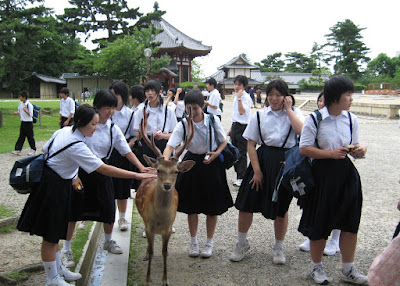
Schoolgirls on a trip to visit the great buddha at Nara


Hats hanging up outside the classroom at another school

Uniforms and uniform backpacks, lunches, school supplies.

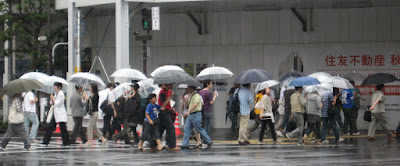
Everyone carries an umbrella