1/19/12

Agile - Levels of Fluency

A quick overview of the Test-driven developmen...
Last night I went to the monthly AgilePDX meeting where James Shore talked about the Agile Fluency(TM) Model.  He began by saying that there’s been an explosion in agile adoption, but there hasn’t been the same growth in the “state of the art.”  Shore said this is disappointing because he wants every team who uses agile to be able to reach the highest success.

Then he began to explain an idea of which he had recently learned through Willem Larsen’s ideas of language fluency (see www.languagehunters.org).  Language, in this case, means natural language, not a programming language. Fluency in a language means that you think in that language – it’s the language you use when you’re woken up at 2 am in a surprising way.

According to Larsen, there are four well-established levels of fluency:
1- Tarzan at the party (eg: “Me want drink. Food”)
2- Getting to the party (eg: “The party is at 8pm, on West 3rd Street”
3- Discussing the party (eg: “What wonderful hors d’oeuvres! I loved Caroline’s dress”)
4- Charley Rose (eg “Speaking of parties, what is the trend this year in centerpieces?”
(those are my examples).

Each level of fluency is useful, although there are greater nuances and capabilities as you reach higher levels.

Shore then suggested that there might be similar levels of fluency in Agile development practices:
Level 0- We build code (but we’re not agile)
  • Domain driven design
  • Programming
  • Database design
  • Configuration management
  • Testing
Level 1- We create value (on a daily basis)
  • Iterations
  • Stories
  • Estimating
  • Planning game
Level 2- We deliver value (as often as our market can accept it)
  • "Done done”
  • Slack
  • Risk driven architecture
  • Velocity
  • Continuous integration
  • Risk management
  • Test driven development
  • Daily standup
  • RABU charts
Level 3- We optimize our value
  • Customer discovery
  • Purpose
  • Concept of “minimum marketable features”
  • Last responsible moment
  • Effect mapping
  • One at a time
  • Adaptive planning
Level 4- We optimize our organization (the work is done where it’s needed, not necessarily your assigned tasks)
  • Systems thinking
  • Lean startup
  • Value-stream mapping
  • One-piece flow
  • ???
Shore worked with Diana Larsen to create the levels, grouping them according to how they’ve seen companies adopt agile development practices. Shore says that in his experience as a consultant most teams he sees are at level 1.  Level 2 is what people think of when they think “Agile,” and consultants are selling the idea of level 3 (although most teams are at level 1). 

In order to move from one level to the next there are certain changes which must occur. To move from level 0 to level 1 means changing your mindset so the team focuses on stories and value, which can sometimes be an eye-opening change.  Moving from L1 to L2 is another change, although slightly more nuanced: the concept of continuous integration, and metrics that allow you to predict development.  Moving up to L3 requires a paradigm shift at the management level of the organization, while L4 means organizational change.  Clearly an organization can’t jump to L4 without each employee becoming fluent in all of the earlier levels.

At this point in the talk we split into groups.  Everyone in the meeting had indicated (a) which level they thought their organization was at, (b) which level they’re working toward, and (c) which level they ultimately hoped for.  It was interesting that most people thought they were at level 1, were working toward level 2, and ultimately hoped for level 3.  That meant that most people didn’t aspire for a fully agile organization – just having a portion of the organization agile was sufficient.

Each group was centered around the level of fluency they hoped to achieve.  In my group, level 2, we talked about continuous integration, “done done,” and test driven development.  Originally I had thought that my development team needed to work more on test driven development, but as we talked, I realized that we’re already working on continuous integration (although we don’t call it that), and that we should continue to work on that until we’re fluent.

Shore then wrapped up the evening by asking us to reflect on what we’d discussed, and to write down one thing to bring back to our organizations. Although I want to explore test driven development (TDD), I’m committing to working on improving our continuous integration until we become fluent in that Agile practice.

Some thoughts about the presentation: It was nice to see a road map of goals for achieving the Agile Fluency (tm) model. Often people talk about agile, and I feel like I’m in a mist, where their concepts appear to be in one spot, then suddenly swirl to another. Laying out the road map this way also provides a common set of terms.  RABU, for example, was a term I hadn't heard before.

On the other hand, I was reminded of a class I had in 1999 on customizing the Capability Maturity Model (CMM) for your organization. Many people in the class seemed to think they could pick & choose the aspects of the model as if moving through a supermarket, which is not the case. In the long run both Shore’s Agile Fluency(tm) model, and the CMM have the same underlying restrictions: In order to achieve the highest levels, individuals and leaders must commit to internalizing – becoming fluent – in the earlier levels of the model.  It’s not enough to say “we’re working toward level three of the Agile Fluency (tm) model,” unless you have internalized levels zero, one and two for both the individuals and the organization.

You can read more about the Agile FluencyTM Model here at Shore's website.
Enhanced by Zemanta

1/4/12

My Top 10 problems with using Scrum

English: The Scrum project management method. ...Image via WikipediaWhat are the top 10 problems I've encountered using an agile methodology like Scrum?

10) The waterfall mindset.  Management prefers the monolithic plan, regardless of how unwieldy it may be. Additionally, development teams who have done waterfall development will tend to slip back into it.

9) Ignoring the "definition of done." Either features that meet the definition stay sticky, where some team members want to further perfect the feature, or the feature is considered "done" without having really been completed.

8) Sprintus-interruptus. Although the team is working in a sprint, management interrupts the team with a high-priority external project.

7) When sizing stories, people start to think of features in absolute sizes rather than relative sizes. Each team is different, so sizing only makes sense to that particular team.

6) It takes a while to get a rhythm for a two-week sprint. Sometimes the team doesn't deliver value until halfway through the sprint, and by then it's almost too late.

5) Stories might be ill-defined.  I've seen stories that omitted who wants it, why, and what's the value.

4) Teams forget to share the work. People prefer to work in their own area, ignoring what other people need or are working on.

3) Team members ignore aspects of Scrum -- such as sizing or prioritizing the backlog. Without a sized, prioritized backlog you aren't managing the process, the project manages you.

2) It's hard to know where and how to document requirements as they evolve

1) People fail to use face-to-face communication.  This is the most efficient way to communicate nuanced information.

Enhanced by Zemanta

12/27/11

The Tao of Frampton

Peter FramptonCover of Peter FramptonAccording to Wikipedia, tao is a Chinese word meaning 'way,' or 'path.'  It seems somehow appropriate to apply this to 70's wunderkind rocker Peter Frampton, who was never known for his lyrics, but really wanted you to show him the way.  In this case, however, the way is how not to write a lyric.  Here are some examples of promising starts, and then a right hook to the brain with a non sequitur.

I can see the sunset in your eyes
Brown and grey and blue besides
Clouds are stalking islands in the sun
I wish I could buy one out of season
BABY, I LOVE YOUR WAY '74

You can't erase a dream you can only wake me up
My mind is turning slower,never to accept defeat
It don't matter where I live I still got a house to heat
LINES ON MY FACE '73

Well, I can see no reason
You living on your nerves
When someone drops a cup and I submerge
SHOW ME THE WAY '74

Enhanced by Zemanta

12/15/11

iPretentious

Apple is so pretentious. This image is from the iTunes wizard to register your iPad. The categories all seem so artistic & fulfilling. I don't see "Quickie Mart attendant," "Truck Driver" or "Waitress."


Enhanced by Zemanta

11/15/11

Mail Order Mysteries

Recently I've extended my diet of podcasts beyond the two staples: "The New York Times Book Review", and "This American Life."  I was looking for comic-book based podcasts, but so many of the so-called reviews are either blow-by-blow recaps of the latest issue of "The Ultimate Spider-man," or blatant fanboy gushing over the cool art, that I began to despair.  Then I discovered boing-boing's "Gweek" podcast.  It's an excuse for Mark Frauenfelder to discover interesting nooks and crannies of comics, pop music, movies and geek pop culture in general.

In "Mail Order Mysteries" Mark interviews Kirk Demarais, who has compiled a book of the ads found in comics in the '60s, '70s and '80s, paired with actual samples of the merchandise which he has tracked down over the years.  As Demarais writes:

"I turned to an overcrowded page of fascinating black-and-white drawings; I was captivated It was an ink-smudged window into an unfamiliar realm where gorilla masks peacefully lived among hovercrafts and ventriloquist dummies. A dozen pages later an outfit called the Fun Factory featured another full-page assortment of wonders, and elsewhere in the issue I found a hundred toy soldiers for a buck, an offer for a free million dollar bank note, and an ad for something called Grit."
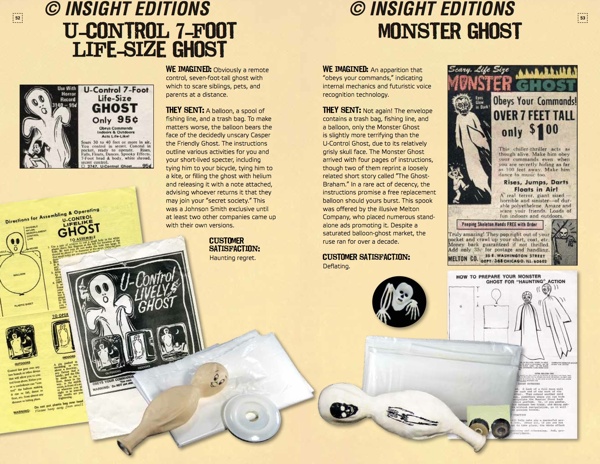
In the interview Frauenfelder asks Demarais what the rarest of these sorts of toys might be.  As I heard the question I figured it would be something like the missile-firing tank, or the rocket-firing submarine.  I figured it would be something large and expensive.  My mind briefly jumped back to the episode of "Get A Life" where Chris Elliot finally gets his Neptune 2000 in the mail.  Not so! It turns out the the rarest mail-order toy is the remote control 7 Foot Life-size Ghost.

I'm alone in the car listening to the interview on the way home from work. So, I'm surprised to hear my own voice aloud in the car. "No freakin' way!"

I remember buying that ghost. I probably cut up a comic to get the coupon, and then probably put my own dollar into the envelope.  I don't remember how long it took to arrive, but when you're in fifth grade anything longer than a week seems like forever.  When it finally arrived I opened the package, which was suspiciously light even if it contained a ghost.  It turns out the "ghost" was a white balloon, a white sheet of plastic indistinguishable from a disposable picnic tablecloth, and a small spool of fishing line.  You were supposed to inflate the balloon, put it under the sheet of plastic, and use the fishing line as the remote control.  I only remember trying it out on my door for about five minutes, and spending maybe five more trying to get my sisters to walk past the ghost and be scared.  After that the balloon probably popped, and it was just so much trash.

So, here's this guy on the podcast talking about trying to buy a vintage 7 Foot Life-size Ghost.  He found one on e-Bay, but other people were bidding it up. Demarais is an associate college professor, and it happened that the auction ended during one of his lectures. At the end of the auction he had to put the class on hold while he attempted to snipe the Ghost.  Unfortunately he lost the auction, but fortunately the winning bidder allowed Demarais to take photos of it for the book.  How much was the winning bid? Over $300!

"No freakin' way!" I said again.  But, I knew it was obvious. The Ghost was such a piece of crap that any that were sold most likely ended up in the garbage before the next dawn.  That's why crazy people end up spending over $300 on a piece of utter ephemera.

Meanwhile, the interview intrigued me enough that I could be convinced to drop the $20 for the book "Mail Order Mysteries" just because of the memories it might bring.


Enhanced by Zemanta

10/3/11

My Bike Commute

Note: This is a longer version of an article I wrote for the Intranet site at work. “Personal Best” is a wellness program launched by ODS.  One of the employees working on the program asked me to write about being captain of the ODS Team for the BTA’s Bike Commute Challenge. Because I wasn't sure what to write, I staged it in the form of an interview.

Me: You're a captain for The ODS Companies team doing the Bicycle Transportation Alliance's Bike Commute Challenge. How did you get that position?
Me: I was just the first to sign up. There are tons of other more worthy people for a Personal Best profile.  I know people who ride every single day, even in winter. I know of one guy who takes the bus to work and rides over 30 miles to get home.  I know--

Me: Excuse me for interrupting, but aren't you supposed to be talking about your "Personal Best?"
Me: Sorry.

A lazy bit of Johnson Creek
Me: You seem to ride quite a bit in the summer. What's your secret to success?
Me: Honestly, I have three secrets.  First off, I have the right equipment: saddlebags are essential for carrying my lunch and extra clothes, and a quick-drying biking jersey makes it easy to always having a clean shirt for the ride.  At work there are showers and locker, great for freshening up after the early morning wake-up ride.  And finally, I've found the SpringwaterCorridor Trail, which works like a secret passageway for cyclists (and pedestrians), is amazing for getting around the East side of Portland.

The Springwater Corridor trail is also great for seeing wildlife.  From downtown it runs along the Willamette, and then turns and follows the Johnson Creek watershed toward Gresham.  Along the way it passes the Oak’s Bottom Wildlife Refuge.  Here’s a short list of the animals I’ve seen while riding on the trail: deer, mice, feral cats, rats, a skunk, a river mink, eagles, heron, osprey, redwing blackbirds and numerous other birds I didn’t identify.

Me: Have you ever had any accidents?
Me: Decades ago (in the 90's!) I was riding to work during “Bike to Work Day.” At a stop sign I bumped tires with another rider and fell over.  I got back up, shook it off, and rode the rest of the way to work.  It wasn’t until my coffee break that I realized my arms were still hurting.  At lunchtime, when I couldn’t lift my peanut butter & jelly sandwich I decided to take the bus home for the day.  Turned out I had broken both arms -- hairline fractures!  After that incident my supervisor convinced me to buy and wear a helmet, which I've been doing ever since. Luckily, I haven't had any accidents after that.

Springwater Corridor under Sellwood Bridge
Me: Do you ride all year?
Me:  I ride as much as I can. In the summer that's multiple times per week. After Daylight Savings Time ends, I prefer to ride once a month.

Me: So, would you say you're a fair weather biker?
Me: I know my limits, and push them whenever I get too comfortable. If you don't ride at all, then just try the ride once. If you ride once a month, then try riding once a week in the summer. If you ride once a week, try two times a week.  I don't like riding in the rain in the morning, but if it's raining on the way home, well, I know I've got some dry clothes at home.  The little things count. Last July I rode to work enough times that I only had to fill up my gas tank once that month.

Me: What inspires you?
Me: There's a woman I see almost daily taking a morning jog on the Springwater Corridor. She's about 70-something, 5' tall, doesn't have a runner's physique, and she's not going very fast. But she lays one foot down in front of the other, and she keeps on going. I see her out there nearly every day.  She's like the Eveready Bunny.  I figure if she can do that every day, the least I can do is give it the same commitment.

Here's a time-lapse video of my ride


Enhanced by Zemanta

7/22/11

Friday Afternoon Chip Smackdown


Why do we eat potato chips? For the crunch? Because they're a transport layer for salt, oil and other spices? Because they're cheap, yet difficult to make at home, so it's a rare-ish treat?  Personally, I've gotten into the bad habit of spicing up the afternoon with a bit of salty and tangy.


So it was, late in the afternoon, stuck debugging a program, I figured it was time to stretch my legs. I wondered down to the lunchroom to see what the chip situation was. Our company recently switched snack vendors, so the options expanded from just the Lay's stable of chips.  Normally I like something jalapeno or habanero, but today I was thinking salt & vinegar.  Maybe it's in anticipation of the Oregon Brewfest next week. There were two kinds available: Dirty Potato Chips in a 2 oz bag for $1.29, and Corazonas in a 1.5oz bag for the same price. 

Tough choice! Normally I'd go for the higher ratio of chips/money, viz the 2 oz bag.  But, in a strange fit of experimentation, I bought both bags for a Friday afternoon chip snackdown.  The results follow.

The Corazonas are lighter, crunchier, with an actual potato taste that reminds me of the fries from fish & Chips plate at The Horse Brass (English pub). That impression is probably helped by the vinegar, which comes across with a malty taste (the ingredients say it's a mix of apple, malt, and white vinegar).

The Dirty Potato Chips, while kettle cooked, actually have a texture closer to Munchos.  They are much greasier than the Corazonas, and at twice the fat (15g vs 9g), I'm not surprised.  The vinegar is also much more in-your-face, with a sharp tang.  According to the label, it's not even vinegar, but a mix of "vinegar powder," citric acid, and malic acid.  I hate to admit it, but I've eaten enough salt & vinegar chips in a sitting that any with malic acid start to hurt my teeth.

Keeping up with the good chip/bad chip roles, the Dirty chips have 80 more calories per bag, with 140 of them from fat.

Meanwhile, the Corazonas practically have a halo on the bag. Not only are they gluten free, but the package says they're infused with plant sterols, which they say lowers LDL (bad) cholesterol. If you eat 0.4 grams of plant sterols twice per day (coincidentally, almost as much as is in a bag of Corazonas potato chips) you'll be on a low cholesterol diet!

Let me conclude before I feel like I'm turning into an info-mercial. Bottom line, I wasn't especially excited by either chip, although I'll probably buy the Corazonas again. They weren't greasy, and the supposed plant sterol benefits are pretty pyschologically compelling.  Also, I appreciated that they used real vinegar and omitted the malic acid.  On the other hand, given a choice between the Dirty chips and the Lay's Salt & Vinegar, I'd probably pick Lay's brand -- the Dirty chips were trying too hard for the price.
Enhanced by Zemanta