11/9/09

Adventures in On-Demand Publishing: Blurb Books

For a number of years my dad, Albert, has written a short memoir for his Christmas card. Each story was also published in car magazines (Goodguys Gazette, and Old Cars Weekly), but I thought it would be fun to gather them in a collection. It would be a holiday storybook for old hot rodders, showing an arc of sixty years' worth of Christmases.

There are many problems with putting out a book like this. For one, it's a niche market so not many publishers are going to flock to your door to promote it. Additionally, my dad's most recent published book, The Age of Hot Rods, took almost a year from completion until it was released. In this case I wanted to get the book published in time for Christmas 2009. On the other hand, if we self-published it I didn't want to have him storing 500 or 1000 copies of the book in his shed for the next twenty years. It's a big investment of money and space to go the traditional route of self-publishing. So, we decided to check out some "on demand" publishing services.

There are a host of these new on demand publishers. I first noticed CreateSpace when they partnered with NaNoWriMo last year, offering participants a chance to publish a copy of their efforts. Meanwhile Blurb Books had been recommended by my aunt, and lulu.com was also impressive. Some resources, such as mypublisher.com, and shutterfly.com looked good, but they seemed oriented toward photo books. In the end I decided Blurb looked the simplest to start with since it had it's own "Booksmart" bookmaking software, while CreateSpace and LuLu both asked for PDF uploads.

Here's a retrospective on the good points, and things I'd like to change about Blurb that I discovered while working on this project.

Good things about Blurb:
  • They have the free "BookSmart" software which guides you through the process
  • The price per book is fair: around $5.95 cost for an 80 page paperback book
  • The layout went quickly, and they provided a quick turnaround in printing.
  • The delivery was easy to track, reliable and on time.
  • The whole process was simple... easy to import your book from MS Word
  • The BookSmart Preview was great. The preview on screen was pretty close to the final bound result
  • The BookSmart software was easy to navigate, and included a spell checker
  • Illustrations were simple. When you load all the images into the Booksmart staging area software tells you if you've used them in the book or not.
  • The software also warns you if your image resolution isn't high enough. That prevents you from printing a book and getting a muddy or jagged picture.
  • You can print out the book for proofreading and it looks like the final result (except it's on 8.5" x 11" paper).
  • The online help was pretty good, although it would be nicer if there was more community support for the book templates.
  • End result was nice. The book looks like a real book
What could be improved:
  • The Blurb service and software is oriented toward photo books, not text.
  • The layout templates for text were limited, and while they may have been cute when paired with large photos, ended up looking childish unless hand-tweaked.
  • It was especially hard to deal with the "auto-flow" templates. If you changed the layout of any auto-flow templates it would break the text flow so that text wouldn't flow from page to page. At that point you have to deal with laying out each page rather than letting the software do it. For that reason alone you want to edit your content as close to perfection as possible before importing into Booksmart.
  • I suggest making backups (BookSmart calls them "archives") each time you finish a stage in your editing. The software auto-saves and you can't turn it off. If you royally mess up, your changes are automatically saved and it's not easy to go back. If you have a backup then you can reload that.
  • The location of the book files on the hard drive isn't obvious. Trying to back up those files to a flash drive can be confusing.
  • The import from MS Word had problems. Tabs were especially bad. The "Styles" imported from Word, but not exactly. The fonts were close, but the justification wasn't at all right, and the leading/kerning was up to the Booksmart software.
  • I couldn't configure tab stops in BookSmart. I wanted a tab stop that was about 5 spaces, but I could only have (a) no tabs, or (b) a tab stop in the middle of the page.
  • Because of the weird layouts I had to tweak the font and alignment of the first paragraph of each chapter by hand.
  • Despite the emphasis on photo books, if you're doing text the photo layouts are limited. Once you have a text layout you're stuck with at most a single picture per page, and it had to be centered and set to a certain size.
  • Line breaks were weird: I had problems with "you'll", and "o'clock" breaking on the apostrophe. Also there were occasionally weird spaces at the end of pages, and gaposis between lines when text had a superscript (such as in "24th").


Despite all the minor problems, my wife Linda managed to edit most of the book, and we were all happy with the end result. The photos and illustrations are clean, and the color cover came out great. The cost per book ($5.95 + shipping) was within my general goal, and the time line was excellent. In fact, from the time we started to lay out the book and add illustrations to the point where the final product arrived on my doorstep was less than 30 days.

Blurb also has some "sell online" features (same with CreateSpace) where you can name your profit margin and they'll sell and ship the books for you. I'm not sure how much shipping per book is, but if you want a copy of the book you can click here.

Bottom line is that Blurb was easy to use, but lacked a certain amount of flexibility. Also, you end up paying for the fancy software because the price of each book is slightly higher than other sites. For the next project my dad was thinking of a book 128 pages in 8"x10" portrait layout. Blurb prices this at about $32 a book, while CreateSpace can deliver this product in the range of $5 a book. But that's mainly because Blurb only offers 8x10 books in full color.

Meanwhile, "Christmas at Ed's Richfield (and Other Stories for Guys)" will be on sale at the Flat Out Press website in time for Christmas.

Reblog this post [with Zemanta]

10/29/09

Agile Project Management software

The Scrum project management method. Part of t...Image via Wikipedia

Here's a list of software systems that ostensibly help manage agile projects. I'm looking at using Rally for our next project at work. Anyone have a good argument to try something else?

Our past two projects used the Scrum framework and were run with a combination of sticky notes, index cards and an Excel spreadsheet. Everything worked great except for a) tracking the sprint burndown, b) reordering the priorities, and c) making sure the spreadsheet had a high visibility.

Some other prerequisites: Free or low cost, secure, uses less time than sticky notes/spreadsheets.


I've left Rational and Primavera off the list. They're too expensive, and too "heavy." I've also omitted Microsoft Project: that's great for setting up and planning a waterfall project, but it's heck to use that for ongoing tasks.

Reblog this post [with Zemanta]

10/14/09

10/3/09

Mason Cat

I found this Mason Cat in my kitchen. I will keep him and feed him butter and pickles and call him Beans. Or maybe I'll feed him beans and call him Pickles.


(In response to the Placenta Teddy Bear)
Posted by Picasa

9/25/09

"How do you like them tomatoes?" 2009

In the book "The $64 Tomato" the author asks the rhetorical question "Why garden?" and then tries to examine his own motives in a series of essays.


I have my own personal answer to the question: the tomato. I want to be able to eat a tomato that's as fresh as possible. One that's never been refrigerated, chilled only by the Portland's cool summer nights. I remember years ago buying a tomato from the local grocery store and cutting it open. It was red, but where was the taste? I almost cried while I ate the stiff tasteless fruit, longing for the fleshy, winey, red specimens I could pick up at almost any market in France. Why do Americans put up with such bland produce (and bread, but that's another story)? The only reason we have these tomatoes is because they're easy to ship across the country and let ripen in the truck or in the back room of the supermarket. I wanted something that was delicate and tasty, warmed by the sun, from the vine to my kitchen.

So, I started a garden. That was 17 years ago. The first year I started all my plants from seed, but a 4'x8' plot won't hold twenty tomato plants, let alone bush beans, lettuce, spinach and hot peppers. Since then I've bought starts in 4" pots from Portland Nursery, tilled some compost, and let them grow in well-turned soil.


Last year I took photos and made notes of which tomatoes were successful, and which were... eh, not so much. My perfect plan was to take this list to Portland Nursery and get exactly the tomatoes I wanted, and then I could shoot in the dark for fillers to replace the less successful plants.


I immediately ran into problems: Portland Nursery changed the layout of their tomatoes, and they were promoting more organic plants. I needed help finding the heirloom tomatoes, and then they had at least three different "German" varieties. I had less trouble locating the Legend tomatoes, but couldn't find the other tomatoes I wanted. I ended up choosing a random Roma, and some other varieties.

In total I bought 8 tomato plants, a cucumber, three hot peppers, three basil plants, and a summer squash. One of the tomatoes (the German Striped) was 100% organic in a compostable pot and bag for $9. The rest were between $1 and $3 a pot. Add to that two cubic feet of Bumper Crop compost and the total outlay for my garden this year was $41.


The results? Mixed.

Early girl didn't live up to its name, ripening a week or so after the first Legends. Also it didn't have nearly as much fruit this year.
In fact, except for the Romas I got almost half as much fruit this year as last. I don't know whether to chalk that up to the heat wave in late July, my change to the watering system (from sprinkler hose to drip hose) or to my compost. Usually I buy chicken manure, but this year opted for the Bumper Crop. Bumper Crop seemed great for the leafy green stuff, but I think I'll stick w/manure for tomatoes and peppers.


Of all the plants the Romas were the best producers. Starting in early August and still going in late September I got enough for several batches of spaghetti sauce (they also mix with other tomatoes to make a good salsa).

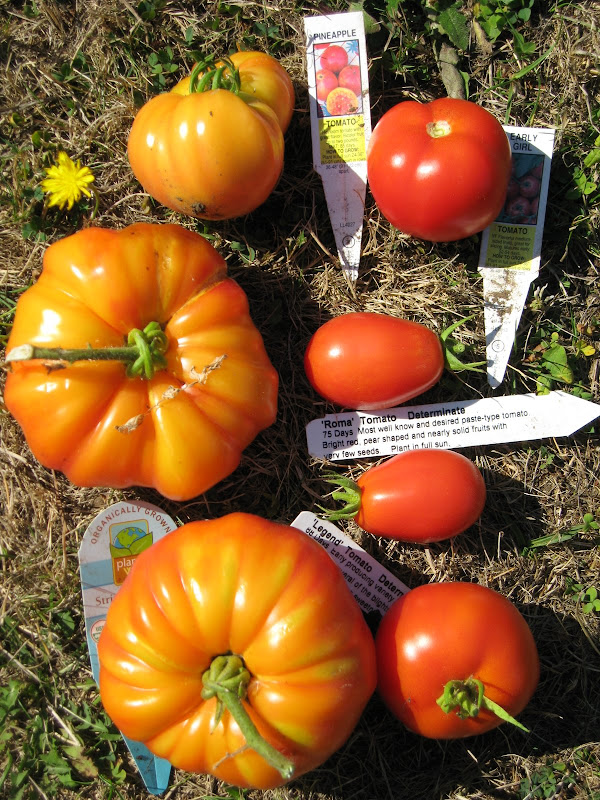
But, for taste, the heirlooms were the clear prize winners. You'll never find either Pineapple or German Striped tomatoes at any grocery store. Both had thin skins, lopsided shapes and ripened into something between yellow and red. The Pineapple tomatoes grew so large my son thought they might be small pumpkins. Unfortunately the thin skins made them attractive to the slugs (who hardly touched any of the other tomatoes), but I had enough to share. A single Pineapple, a half an onion, and some cilantro was enough to make a healthy bowl of fresh salsa. The German Striped tomatoes were almost sweet, and I blended up one to make a sauce for a pizza that the family said was "the best ever."

Thus endeth my gardening log for this year. Next year we'll see if I can find any of the same tomatoes. In the meantime, my final answer to "Why Garden?" is "the secret is in the sauce."


Download Portland Nursery's Veggie Calendar


A sample of the bounty


Reblog this post [with Zemanta]

9/20/09

Making Mozzarella or Cheesemaking Made Easy


Today I stopped in at the Montavilla Farmers Market and picked up a Mozzarella and Ricotta making kit from UrbanCheesecraft (she has a site on etsy www.urbancheesecraft.etsy.com). For $20 the kit comes with enough vegetarian rennet, cheese salt and citric acid for 30 batches of cheese. There's also a cheese thermometer and some cheesecloth.

I'd read about cheesemaking on the internet, and had looked at some mail order sites, so this seemed like a fair price and a fun project. I'd also made yogurt and labneh before, so while she also had kits for chevre or paneer, I felt like Mozzarella was the next step for me.

The pamphlet says you'll have mozzarella in about an hour, so I gave it a try. The instructions were clear and easy to follow. I used a gallon of whole milk and it made almost a pound of Mozzarella.

Here's a shot of the curds while they're cooking. This is about 20 minutes into the process:


The end result isn't very photogenic, but tasty:

She suggests you can add herbs, pepper flakes, or sun-dried tomatoes to the cheese to zest it up. I plan to try some tomato, mozzarella and basil paninis (I used some of the leftover whey to make some no-knead bread).

The kit was great! Check it out.
Reblog this post [with Zemanta]